Réponse courte
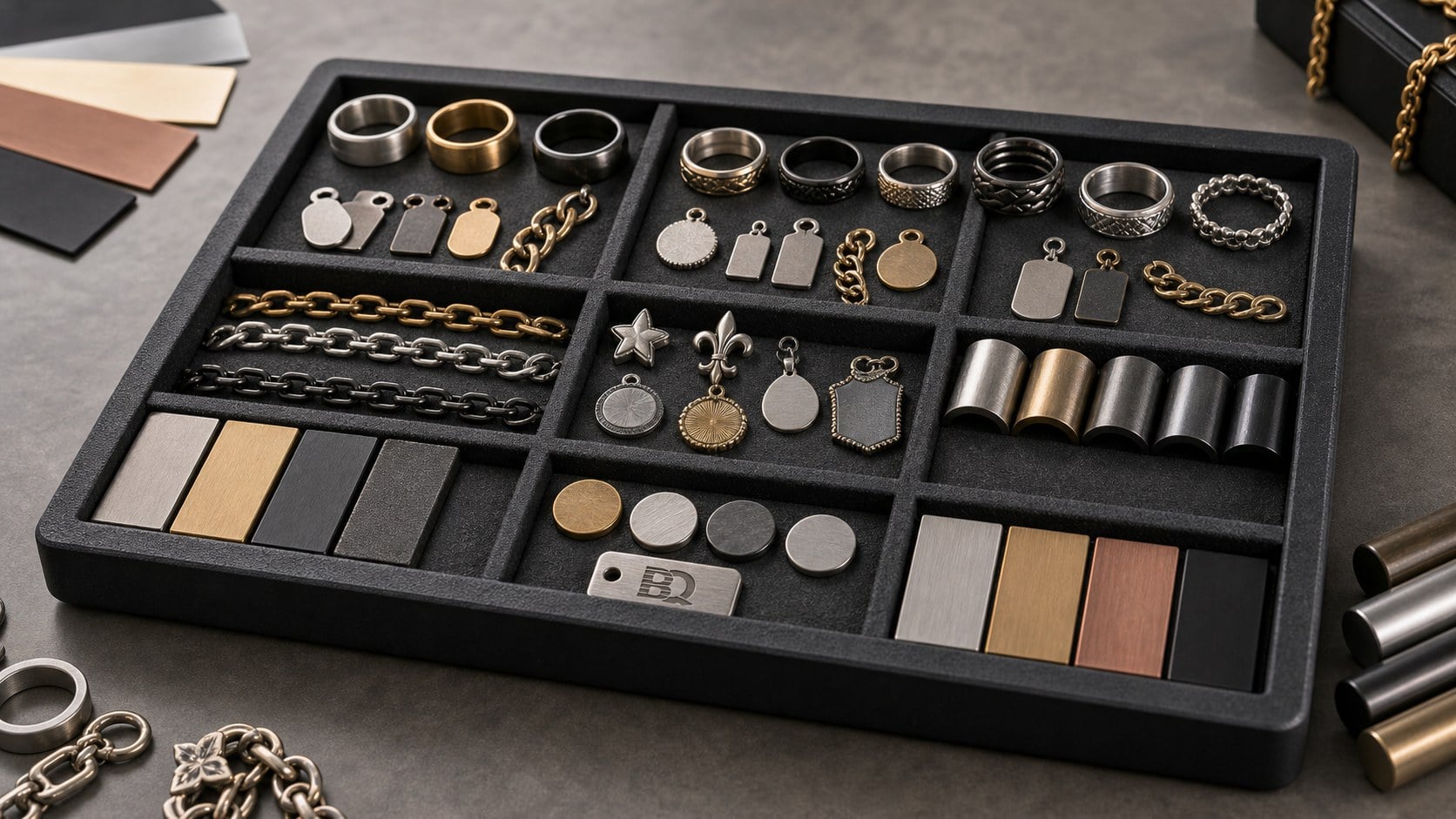
Le choix du matériau idéal pour les bijoux fantaisie personnalisés dépend du type de produit, des détails du design, des finitions souhaitées, de la durabilité attendue, du positionnement cible et des risques liés à l'échantillonnage. L'alliage de zinc, le laiton, l'acier inoxydable et l'argent sterling peuvent tous convenir, mais répondent à des besoins différents.
Pour de nombreux accessoires de mode, le choix du matériau ne doit pas être pris isolément. L'acheteur doit le choisir en tenant compte de la structure du produit, du type de logo, du placage ou de la finition PVD, des détails en pierre ou en émail, de la résistance à l'usure prévue, de l'emballage et des critères d'approbation des échantillons.
Si vous souhaitez commander un bijou sur mesure, veuillez transmettre au fabricant votre illustration ou une image de référence, les dimensions, la finition souhaitée, le matériau de votre choix, la quantité désirée, ainsi que tout logo ou détail de surface particulier. Ces informations permettront de recommander le matériau avec plus de précision que de simplement demander « le meilleur métal ».
Choix des matériaux en bref
| Source | Meilleur ajustement | Détail de la conception | Ajustement final | Note sur la durabilité | Impact budgétaire | Contrôle de l'échantillon | Éviter quand |
|---|---|---|---|---|---|---|---|
| alliage de zinc | Breloques décoratives, pendentifs, accessoires de mode, formes complexes | Idéal pour les formes décoratives moulées et les détails en relief | Souvent associé à des finitions plaquées, émaillées, époxy ou peintes. | Convient à de nombreux articles de mode, mais pas le premier choix pour les pièces structurelles soumises à une forte usure. | Généralement utile pour les objets décoratifs à petit budget | Vérifiez la régularité de la surface, la couverture du plaquage, la précision des bords et le poids. | À éviter lorsque la pièce nécessite une résistance structurelle élevée ou des bords de précision très fins. |
| Laiton | Bijoux plaqués de qualité supérieure, breloques, pendentifs, étiquettes personnalisées, formes riches en détails | Idéal pour les finitions de surface fines et de nombreuses finitions de type bijouterie | Fonctionne bien avec le plaquage et les finitions antiques lorsque le processus est maîtrisé. | Plus tendre que l'acier inoxydable ; la protection de la finition et les attentes en matière de ternissement sont importantes. | Peut offrir une sensation plus haut de gamme que l'alliage de zinc tout en restant pratique pour les bijoux fantaisie. | Vérifier la couleur du plaquage, la finition des bords, la netteté de la gravure et les prévisions de ternissement/oxydation | À éviter si l'acheteur s'attend à une dureté comparable à celle de l'acier inoxydable ou à un entretien minimal. |
| Inox | Bagues résistantes, bracelets, éléments de chaîne, breloques minimalistes, accessoires contemporains | Idéal pour les formes nettes ; les détails en relief/profondeur très fins peuvent nécessiter une révision du processus. | Compatibilité optimale avec les finitions polies, brossées, noires et de type PVD | Solide et résistant à la corrosion, idéal pour de nombreux articles du quotidien. | Souvent choisi pour sa durabilité plutôt que pour son aspect décoratif à moindre coût. | Vérifiez le parcours d'usinage/d'estampage, le confort des bords, la couleur de finition et la méthode de logo. | À éviter lorsque la conception repose sur un relief de fonderie complexe, plus facile à réaliser dans des alliages plus tendres. |
| Argent sterling | Bijoux fantaisie haut de gamme, collections positionnées sur un excellent rapport qualité-prix, pièces perçues comme ayant une valeur supérieure | Idéal pour les détails de haute joaillerie avec le bon procédé | Fonctionne avec le polissage, le plaquage, l'oxydation et les motifs liés à la pierre | Nécessite de l'entretien et peut se ternir ; les attentes de l'acheteur doivent être claires. | Positionnement plus valorisant des matériaux et discipline d'échantillonnage accrue | Vérifiez le polissage de la surface, le sertissage des pierres, le choix du plaquage et les consignes d'entretien. | À éviter lorsque le projet nécessite principalement un article promotionnel à budget limité |
Alliage de zinc : flexible pour les pièces décoratives de mode
L'alliage de zinc est souvent privilégié pour les bijoux fantaisie personnalisés présentant une forme décorative, un logo sculpté ou une forme complexe rappelant un pendentif. Il est généralement choisi lorsque l'acheteur recherche une grande flexibilité de conception et une production pratique.
Pour les commandes personnalisées, l'alliage de zinc est idéal lorsque l'acheteur définit précisément l'effet de surface souhaité. Un pendentif, une breloque ou un petit accessoire moulé peut présenter un aspect très différent selon la couleur du plaquage, le remplissage en émail, l'époxy, le polissage, l'épaisseur des bords et l'emballage. Si l'acheteur ne fournit qu'une image basse résolution et demande un devis, le choix du matériau risque d'être moins important que les détails manquants.
Utiliser un alliage de zinc lorsque :
- Le motif présente des reliefs décoratifs, des courbes ou des formes personnalisées.
- Ce produit est un accessoire de mode plutôt qu'une pièce structurelle soumise à de fortes contraintes.
- L'aspect final dépend du placage, de l'émail, de l'époxy ou de la peinture.
- L'acheteur a besoin d'un itinéraire personnalisé pratique pour un article de collection.
Soyez prudent lorsque :
- La pièce est très fine sur le bord.
- Le design comporte des saillies pointues qui peuvent se plier ou s'avérer inconfortables.
- L'acheteur s'attend à une résistance à l'usure à long terme similaire à celle de l'acier inoxydable.
- Le logo ou les détails de surface seront évalués à très petite échelle.
Laiton : Idéal pour le toucher et la finesse des détails de surface des bijoux plaqués.
Le laiton est un excellent choix pour les bijoux fantaisie, notamment lorsqu'on recherche une sensation haut de gamme, des finitions soignées et un plaquage impeccable. Il est fréquemment utilisé pour les breloques, les étiquettes, les pendentifs, les ornements de bracelets et autres pièces de bijoux.
La question essentielle n'est pas simplement de savoir si le laiton est un bon matériau. Il est plus pertinent de se demander quelle finition sera appliquée, comment la surface sera protégée et comment évaluer l'échantillon. Le laiton permet d'obtenir des effets plaqués et vieillis attrayants, mais l'acheteur doit s'assurer de la couleur, du poli, de la douceur des bords et des conditions d'entretien.
Utilisez le laiton lorsque :
- La pièce doit paraître plus robuste qu'un simple alliage décoratif.
- Le design bénéficie de détails de surface fins.
- Le plaquage ou la finition antique font partie intégrante de l'identité du produit.
- L'acheteur souhaite un résultat comparable à celui d'un bijou, sans pour autant passer directement à l'argent.
Soyez prudent lorsque :
- L'acheteur s'attend à une surface ne nécessitant aucun entretien.
- La couleur de finition doit correspondre à une norme de marque stricte sans approbation d'échantillon.
- La conception intègre des points de contact avec la peau qui nécessitent une révision des matériaux et des finitions.
Acier inoxydable : durable, moderne et résistant, il convient à de nombreuses lignes de bijoux.
L'acier inoxydable est souvent privilégié pour la création de bijoux fantaisie durables : bagues, bracelets, chaînes et accessoires minimalistes. Il est apprécié pour son esthétique moderne et épurée, sa résistance à l'usure et sa parfaite compatibilité avec les finitions polies, brossées, noires ou de type PVD.
Avant de verrouiller le matériau, vérifiez l'épaisseur de l'acier inoxydable, le logo et les échantillons par rapport à la géométrie de conception réelle et à la position d'usure.
Le compromis réside dans la facilité de fabrication. L'acier inoxydable étant plus dur que les alliages plus tendres utilisés en joaillerie, le procédé de fabrication est crucial. Un simple anneau, un maillon de chaîne ou une plaque plate peuvent être faciles à réaliser. En revanche, un relief décoratif profond, un logo sculpté minuscule ou une forme organique complexe peuvent nécessiter un procédé différent ou un matériau différent.
Utilisez l'acier inoxydable lorsque :
- L'acheteur souhaite un produit durable pour un usage quotidien.
- Le design est épuré, moderne ou structurel.
- Une finition de type PVD ou un métal poli/brossé est important.
- Le produit est une bague, un bracelet, un élément de chaîne, un pendentif vierge ou un accessoire minimaliste.
Soyez prudent lorsque :
- La conception dépend de détails complexes de moulage.
- La pièce nécessite un relief marqué, un logo en relief très petit ou une texture inhabituelle.
- L'acheteur part du principe que l'acier inoxydable s'adaptera automatiquement à toutes les finitions et à tous les designs.
Argent sterling : un positionnement haut de gamme aux attentes différentes
L'argent sterling se justifie pleinement lorsqu'une collection recherche une valeur matérielle, un positionnement haut de gamme ou pour une catégorie de bijoux où les acheteurs privilégient l'argent. Il permet des finitions soignées et des détails raffinés, mais implique également des exigences différentes en matière d'entretien, de ternissement, d'échantillonnage, d'emballage et de contrôle qualité.
Pour une production sur mesure, le choix de l'argent doit être une décision stratégique en matière de positionnement produit. Il ne s'agit pas simplement d'une version plus onéreuse d'un autre matériau. L'acheteur doit prendre en compte le segment de marché visé, la finition, le plaquage, le sertissage des pierres, le niveau de polissage et les conseils d'entretien.
Utilisez l'argent sterling lorsque :
- La marque a besoin d'une histoire axée sur des matériaux haut de gamme.
- Ce produit s'apparente davantage à un bijou qu'à un accessoire promotionnel.
- L'acheteur peut exiger un contrôle plus strict des échantillons et des conditions d'emballage.
- La conception justifie la valeur du matériau.
Soyez prudent lorsque :
- L'acheteur a principalement besoin d'un article à petit prix.
- Les comportements attendus en matière de soin et de dégradation ne sont pas compris.
- Le design sera fortement plaqué et l'histoire de l'argent n'aura aucune importance pour le client final.
Comment la finition influence le choix du matériau
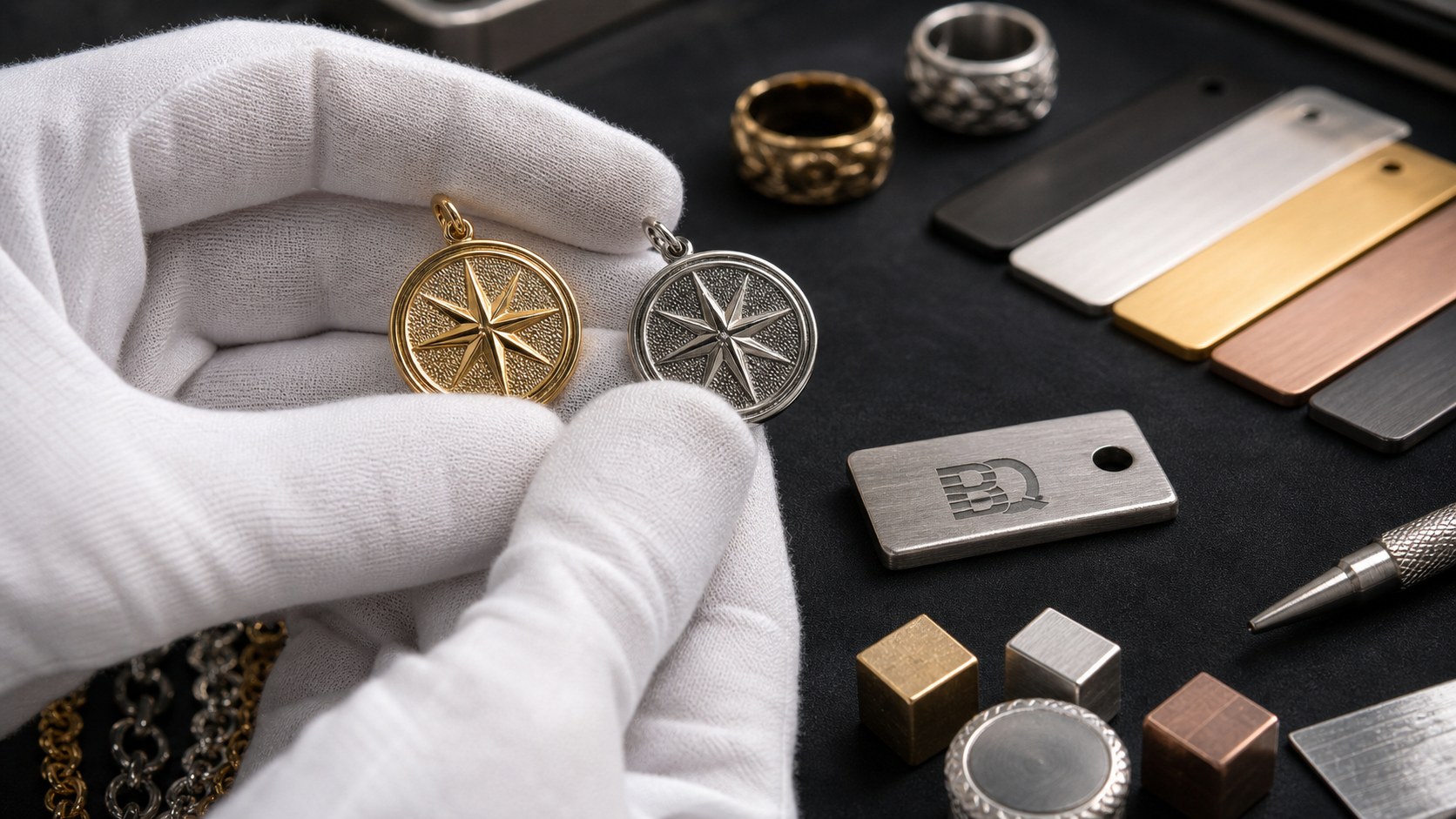
Le matériau et la finition doivent être choisis conjointement. Un acheteur peut commencer par demander du laiton, de l'acier inoxydable, un alliage de zinc ou de l'argent, mais le choix final dépendra également du système de finition.
Par exemple :
- Les finitions de type PVD sont souvent associées à l'acier inoxydable et aux pièces modernes et durables.
- Le procédé de galvanoplastie peut être utilisé pour de nombreux matériaux utilisés en bijouterie et pour les accessoires, mais le matériau de base, la préparation de la surface et la géométrie de la pièce sont importants.
- Les détails en émail ou en époxy peuvent dépendre davantage des zones en retrait, de la séparation des lignes métalliques et de l'approbation de l'échantillon que du seul nom du matériau.
- Les effets antiques, les textures brossées et le polissage nécessitent une surface suffisante et des attentes réalistes.
Si la finition est un élément essentiel du produit, consultez le guide des finitions avant de finaliser votre choix de matériau :
https://baiqueaccessories.com/blog/how-to-choose-between-pvd-and-electroplating-for-fashion-jewelry-and-accessories-in-just-3-minutes/
Que faut-il envoyer avant l'échantillonnage ?
Avant de demander une recommandation sur un point précis, préparez les informations qui influenceront cette recommandation :
- Type de produit : bague, collier, bracelet, breloque, pendentif, broche, étiquette, boucle ou accessoire mixte.
- Utilisation prévue : collection de mode, article promotionnel, cadeau haut de gamme, bijou à porter au quotidien, produit événementiel ou accessoire d’emballage.
- Dimensions : taille réelle, épaisseur cible et points de confort importants.
- Illustrations : fichier logo modifiable si disponible, plus image de référence ou maquette.
- Méthode de logo : gravure, débossage, gaufrage, relief, remplissage d’émail, impression ou sertissage de pierre.
- Finition cible : dorée, argentée, noire, or rose, antique, brossée, polie, style PVD, émaillée, époxy ou mixte.
- Objectif de quantité : suffisant pour discuter de la quantité minimale de commande (MOQ), sans supposer une MOQ universelle.
- Objectif type : ce qui doit être vérifié avant la production.
- Emballage et manutention : vérifier si la surface risque de se frotter, de se rayer ou de s’oxyder pendant le stockage ou le transport.
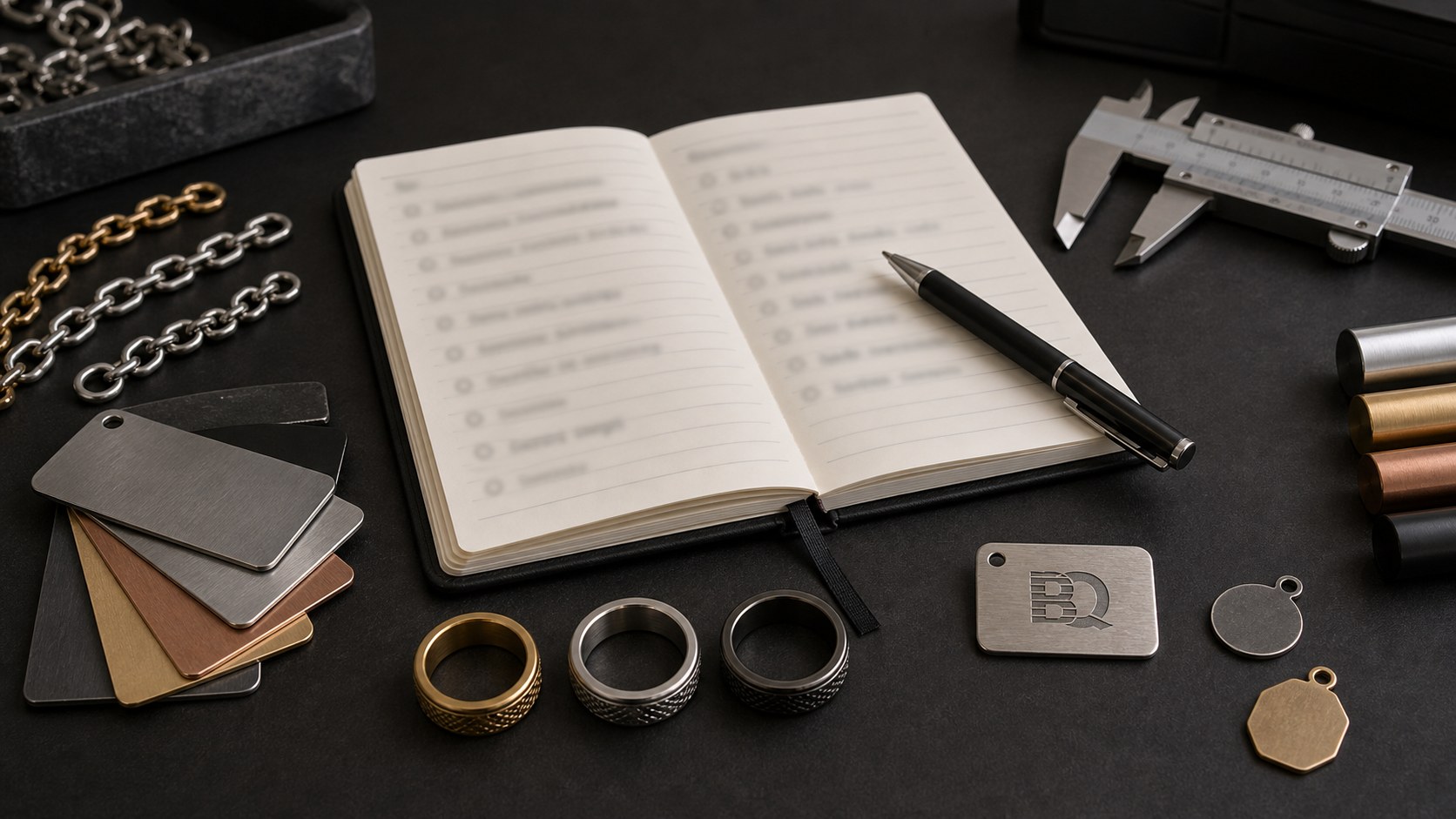
C’est pourquoi le choix des matériaux doit souvent être abordé au même titre que la création graphique et l’échantillonnage. Un matériau qui semble convenir sur un nuancier peut ne pas être adapté à un logo, une finition ou une structure de produit spécifique.
Erreurs courantes des acheteurs
L'erreur la plus fréquente consiste à choisir un nom de matériau avant d'expliquer le produit. « Acier inoxydable » ou « laiton » ne suffisent pas si le fabricant ignore les dimensions, la finition, le procédé de fabrication du logo et l'usage prévu.
Une autre erreur consiste à exiger la solution la plus économique tout en espérant une finition de surface impeccable et une grande durabilité. Ces objectifs peuvent être contradictoires. Un fabricant avisé devrait aider à identifier le compromis, et non prétendre qu'un seul matériau répond à tous les besoins.
Une troisième erreur consiste à juger l'échantillon uniquement sur sa couleur. Pour les bijoux fantaisie sur mesure, l'examen de l'échantillon doit également inclure :
- Lissage de la surface.
- Confort de bord.
- Clarté du logo.
- Revêtement par plaquage ou PVD.
- Bords émaillés ou époxy, le cas échéant.
- Chaîne, fermoir, anneau ou connecteur compatibles.
- Risque de contact et d'abrasion de l'emballage.
QFP
Quel est le meilleur matériau pour les bijoux de mode personnalisés ?
Il n'existe pas de matériau idéal. L'alliage de zinc, le laiton, l'acier inoxydable et l'argent conviennent à différents objectifs. Le choix dépendra des détails de conception, de la finition, de la durabilité, du budget et des attentes concernant les échantillons.
L'acier inoxydable est-il meilleur que le laiton pour la joaillerie ?
L'acier inoxydable est généralement plus résistant et plus durable face à la corrosion, tandis que le laiton convient aux bijoux plaqués, aux formes complexes et aux pièces de mode haut de gamme. Le choix le plus judicieux dépend de la structure du produit, de sa finition et de la clientèle visée.
L'alliage de zinc est-il suffisamment bon pour la fabrication de bijoux sur mesure ?
L'alliage de zinc peut convenir à la fabrication de bijoux fantaisie, de breloques, de pendentifs et d'accessoires lorsque sa structure et sa finition sont appropriées. Il ne doit cependant pas être considéré comme le matériau de choix par défaut pour tous les articles soumis à une forte usure ou présentant des caractéristiques structurelles particulières.
Une nouvelle marque de bijoux devrait-elle commencer par l'argent ou l'acier inoxydable ?
Cela dépend du positionnement. L'acier inoxydable convient parfaitement aux collections modernes et durables, tandis que l'argent évoque un matériau plus haut de gamme. La décision doit prendre en compte le design, la finition, le budget, les échantillons et les consignes d'entretien.
Comment le plaquage ou le PVD influencent-ils le choix des matériaux ?
Le procédé de finition peut modifier le choix du matériau. Une finition de type PVD, un traitement électrolytique, un émail, un revêtement époxy, un effet vieilli, une texture brossée ou un polissage doivent être discutés avant le choix définitif du matériau.
Étape suivante
Si vous envisagez un projet de bijouterie sur mesure, veuillez transmettre à Baique le type de produit, le visuel ou l'image de référence, les dimensions, la finition souhaitée, le matériau de votre choix, la quantité désirée et vos attentes concernant les échantillons. Baique pourra ainsi déterminer si un alliage de zinc, du laiton, de l'acier inoxydable, de l'argent ou un autre matériau est plus adapté à votre création.
Commencez par la page principale du service :
https://baiqueaccessories.com/fashion-jewelry-manufacturer/


Andy est un expert renommé dans la fabrication de bijoux de mode avec une connaissance approfondie du secteur. Il fournit des services OEM/ODM aux marques de mode et aux bijoutiers, transformant les idées en produits tangibles. En plus de la qualité, Andy fournit des conseils stratégiques sur les tendances du marché et les innovations en matière de fabrication pour aider les clients à se démarquer sur un marché concurrentiel.